We Uses Cookies
This website uses cookies to enhance
your browsing experience.
Contact US
We Uses Cookies
This website uses cookies to enhance
your browsing experience.
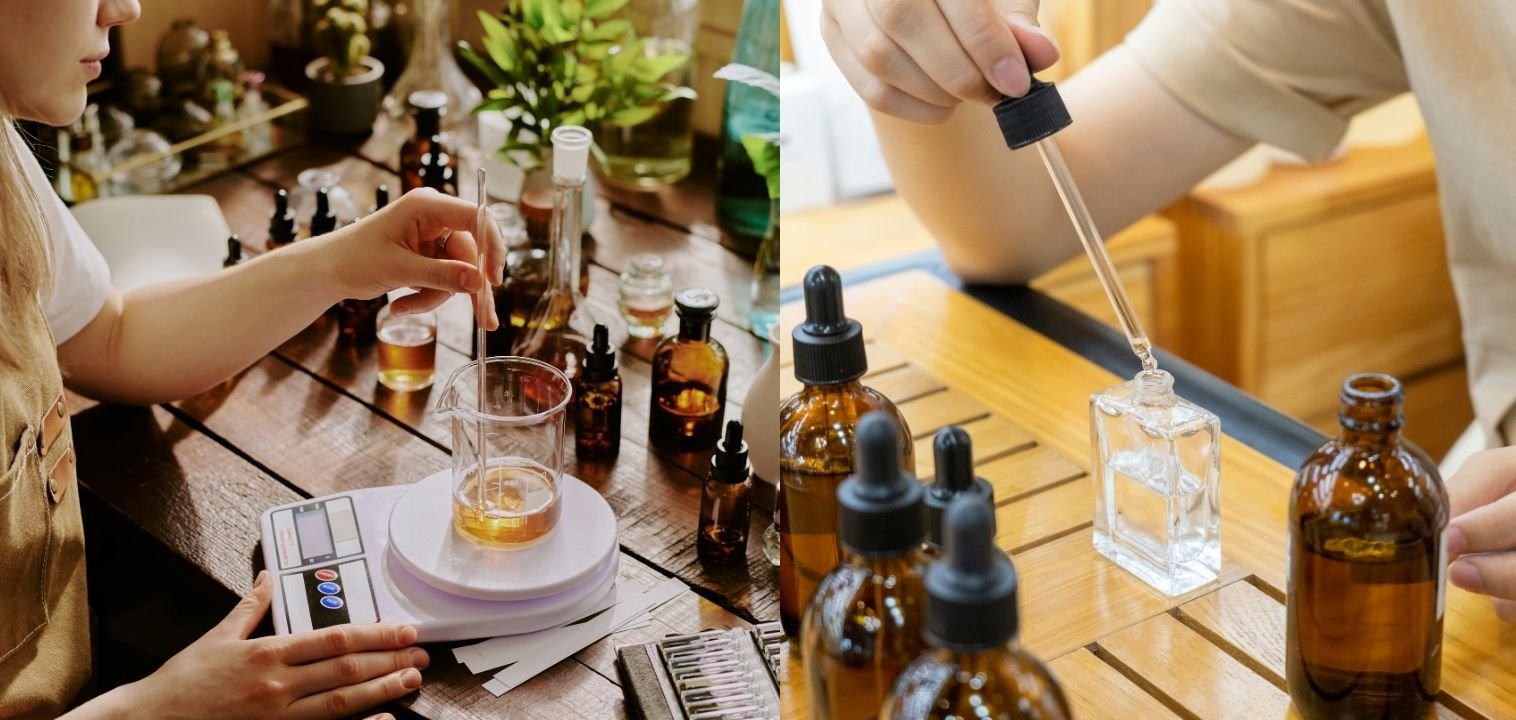
A friend of mine once spent forty minutes in a perfume store in GK-1, sniffing one tester after another, buying nothing. She left with a mild headache and one firm decision: "I want to know how they actually make this." That's usually how it starts, not with a business plan, but with a bottle you love, or one you couldn't stand, and a stubborn curiosity about what's inside it.
The good news is that curiosity turns into a usable skill faster than most people expect, and Delhi happens to be a genuinely good city to learn it in. Old attar traditions still run through Chandni Chowk, one of the few functioning raw-material markets of its kind in the country, alongside a fast-growing appetite for small, independent fragrance brands. If you've been weighing a perfume making course in Delhi, here's what it actually involves, what you'll learn, who it suits, how to tell a solid course from a mediocre one, and what you can realistically build with the skill afterward.
Five years ago, barely anyone outside the fragrance industry was searching for this. A few things changed that.
Part of it is fatigue with mass-market perfume. Walk into any large retail chain and you'll find the same twenty-odd bottles on every shelf, made by a handful of big houses. People got tired of smelling identical to everyone else at a wedding, and small-batch, personalized scent appeals precisely because it isn't mass-produced.
There's also real demand for natural and alcohol-free options. Buyers with sensitive skin, or those who simply prefer traditional Indian ittars over synthetic Western perfumes, have pushed interest toward smaller producers working the old way.
Then there's the business angle. Indian wedding season runs on gifting, trousseau boxes, corporate hampers, return gifts, and a well-packaged custom perfume fits naturally into all of it. Add Instagram and WhatsApp Business, and a shop isn't even necessary anymore; someone running this from a spare room in Rohini can sell to a customer in Bengaluru without either ever meeting in person.
Delhi sits at the intersection of all this: raw-material access, a large customer base, and a culture where fragrance has always carried weight.
Most people assume perfume-making means pouring a few nice-smelling oils into a bottle and shaking it. It doesn't, and that gap between assumption and reality is exactly what makes the craft interesting once you're inside it.
Note type | What it is | Example ingredients |
Top | Hits first, fades within minutes | Citrus, mint |
Middle | The "heart," emerges once top notes fade | Rose, jasmine, cinnamon |
Base | Lingers for hours | Sandalwood, musk, amber, vanilla |
A good instructor won't just explain this on a whiteboard, they'll have you smell a test strip at the ten-minute mark and again two hours later, so you experience the shift rather than just memorize it.
Better courses go one step further into packaging and business basics, bottle sourcing, labeling requirements, pricing, and basic brand identity. A well-made scent in an unlabeled bottle is still a hard sell.
No chemistry background, design degree, or prior cosmetics experience is required, and that's not a marketing line. It's genuinely one of the more accessible creative courses out there.
Students tend to be a varied mix:
What matters more than background is a willingness to actually work with the ingredients yourself, rather than watching someone else do it.
Chandni Chowk and the surrounding wholesale markets have supplied attar makers, spice traders, and perfumers for generations. That history gives the city a functioning ecosystem of suppliers dealing in essential oils, aroma chemicals, absolutes, and carrier bases, infrastructure most other Indian cities don't have at the same scale.
For a new perfumer, this matters more than it sounds. Sourcing quality raw material is usually one of the biggest hurdles once a course ends and you're formulating on your own. Elsewhere, that often means relying entirely on online suppliers with no way to smell or verify what you're buying before it arrives. In Delhi, a trained perfumer can walk into these markets, evaluate ingredients directly, build supplier relationships, and negotiate fair pricing, something a good course will usually walk you through, rather than leaving you to figure out through trial and error.
This local advantage is also part of why so many small, independent Delhi-based fragrance brands have launched with relatively modest starting capital. Lower material costs and direct supplier access mean the barrier to entry is genuinely lower here than in cities where every ingredient has to be shipped in.
Certification matters more than most people initially assume, particularly if there's any chance of using the skill professionally later.
Anyone who's tried mixing oils at home before formal training has probably run into most of these already.
This is the part most newcomers underestimate.
Many students go on to start a home-based perfume brand, small-batch, signature scents sold online or at local exhibitions. Others focus specifically on custom, personalized perfume, a genuine niche now that customers increasingly want something made for them rather than bought off a shelf. Anyone already running a soap, candle, or skincare business can use the skill to formulate original fragrance instead of buying it pre-made, which typically improves both margins and product distinctiveness.
Wedding and gifting entrepreneurs have found it a natural extension for trousseau and corporate hampers. Some eventually run their own mini workshops, popular for kitty parties, birthdays, and corporate team outings turning the teaching itself into a small income stream. And a fair number simply keep it as a serious hobby, with no intention of selling anything, because creating a scent that's entirely your own is satisfying on its own terms.
Compared to cosmetic manufacturing or skincare production, which typically demands more equipment and regulatory awareness, perfumery is one of the more affordable creative skills to pick up. Most Delhi institutes price these courses to be accessible to hobbyists and small entrepreneurs, and several run seasonal discounts around enrollment.
Time commitment depends on ambition. A single intensive weekend workshop suits someone who's simply curious. A longer, multi-week format suits someone considering this as a business, since it typically covers formulation, sourcing, and pricing in greater depth.
One thing worth setting expectations around: no one leaves a single class able to replicate a designer fragrance from memory. The course gives you the correct foundation, accurate vocabulary, and enough hands-on repetition to stop guessing. Genuine refinement comes afterward, through continued practice, which, for most people drawn to this craft, turns out to be the most enjoyable part anyway.
Structure varies by institute, but most solid programs move through similar ground:
Some academies compress this into a single intensive session; others spread it across several weeks. For anyone planning to sell what they make, the longer format is generally worth the extra time.
No. This course is built for complete beginners, ingredients, ratios, and blending are all taught from scratch. What helps more than prior knowledge is patience and a willingness to actually work with the materials yourself rather than just watch a demonstration.
It varies by institute. Some run as one- or two-day intensive workshops for curious hobbyists, while others stretch across several weeks for people who want deeper, business-oriented training covering formulation, sourcing, and pricing.
Many students do launch a small home-based brand afterward. Most solid courses also cover packaging, labeling, and basic pricing to support that step, though real refinement of your formulas usually comes from continued practice after the class ends.
It comes down to concentration and base. Attars are traditionally oil-based with no alcohol, while EDT and EDP are alcohol-based, differing mainly in how much fragrance oil each one contains — EDP holds a higher concentration than EDT.
Reputed academies, including Craft Tree Academy, provide a completion certificate. This carries real weight if you're planning to sell or teach the craft professionally later, since it adds credibility beyond just having taken a class.
Chandni Chowk and nearby wholesale markets have supplied perfumers and attar makers for generations, giving the city a rare, functioning ecosystem of raw-material suppliers. That means you can evaluate ingredients in person rather than buying blind online.
Overloading a blend with too many notes, chasing strength instead of balance. A close second is judging a perfume too soon, a fresh blend smells different hours or days later, and skipping that maturation period often means bottling an unfinished scent.
Small batch sizes, hands-on mixing rather than mostly slides, transparency about where raw materials are sourced, a trainer with real commercial formulation experience, and support available after the course ends for sourcing or formula questions.
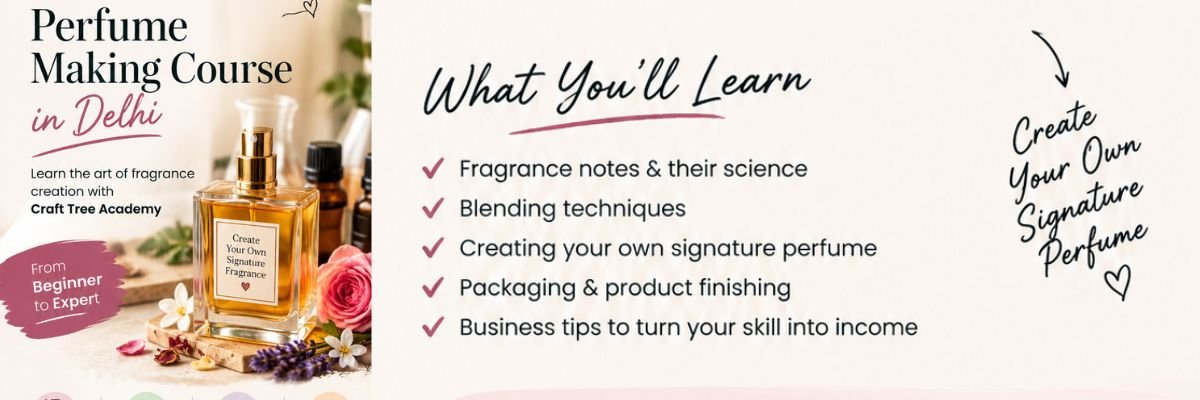
Craft Tree Academy's perfume making course in Delhi is built around genuine formulation work rather than a lecture with a demo bottle passed around the room. Students work through fragrance notes, build their own accords, and leave with a signature scent worth selling, not just a jar of something that smells pleasant. As an ISO 9001:2005 certified academy with a track record across skincare, cosmetics, resin art, and several other crafts, the same small-batch, hands-on teaching style applies here, backed by a completion certificate that holds credibility for anyone planning to use the skill professionally.
For anyone who's been considering this for a while, and many people sit on the idea for years the most direct way forward is simply to begin.
Interested in joining the batch? Reach out to Craft Tree Academy at info@crafttreeacademy.com or call +91-9643792145 / +91-9873504819 to know more about the Perfume Making Course in Delhi.
Our Academy is driven by a strong team of professionals and provide training required for a successful venture.

Block AA- 256-1st floor, near Fortis hospital Shalimar Bagh Delhi -110088

© 2019 Craft Tree Academy All Rights Reserve Designed & Powered By Website99